Time Perception: Why Life Feels Faster as You Age
Ever feel like years are flying by? It's not just in your head. Dive into the neuroscience of time perception and the 'Proportional Theory' that explains why your summers felt endless as a child but fleeting as an adult.
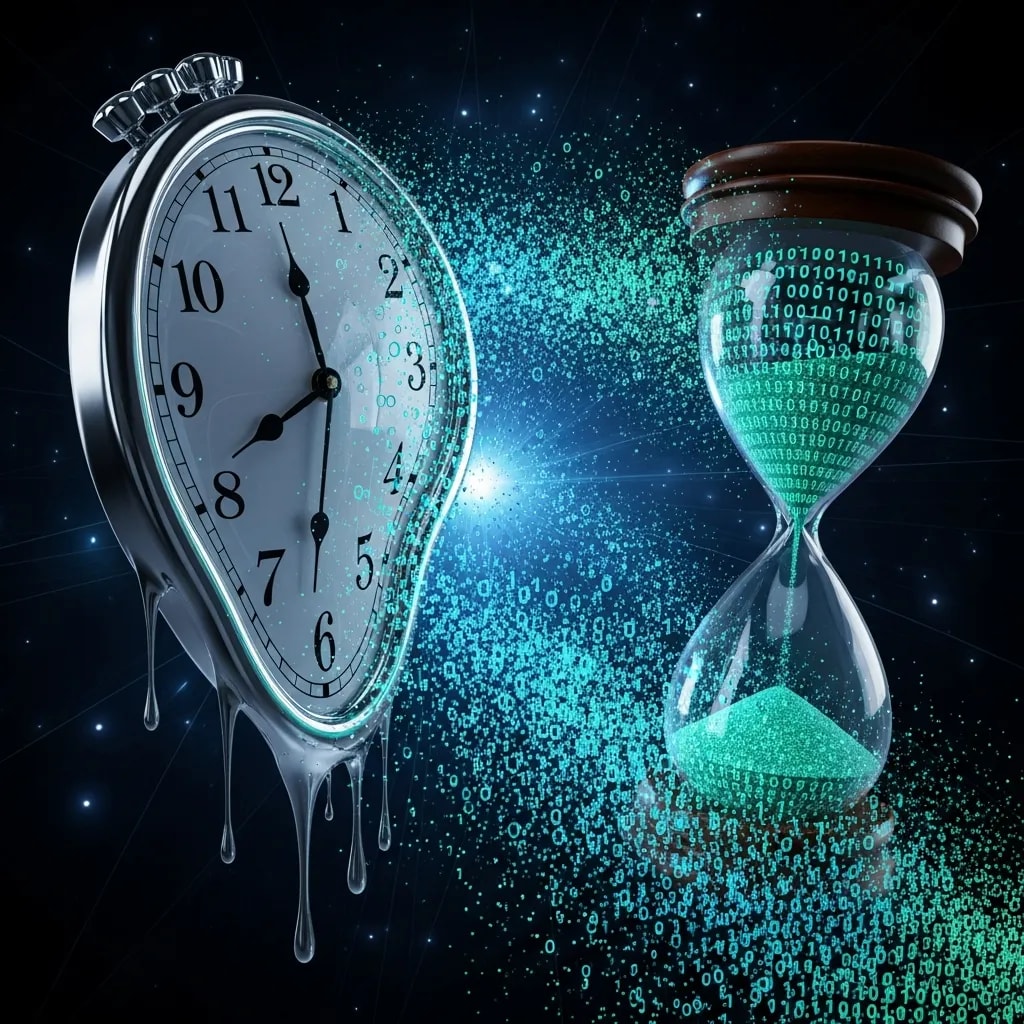
The Acceleration of Time: A Universal Human Experience
We've all experienced it. When you're a child, a summer vacation stretches out like an eternity. The days are long, filled with endless possibilities. Fast forward to your 30s or 40s, and suddenly, entire seasons seem to vanish in the blink of an eye. "Christmas was just last week," you might say, realizing it was actually three months ago.
This phenomenon is a universal human experience, documented across cultures, languages, and centuries. But why does it happen? Is the universe speeding up? Is your brain broken? No — the answer lies in the complex machinery of the human brain and at least four distinct neurological mechanisms that conspire to make subjective time accelerate as you age.
Understanding these mechanisms isn't just an intellectual exercise — it's a practical toolkit for slowing down your perception of life and living more fully. Use our Exact Age Calculator to see your age in seconds, then read on to discover why those seconds feel so different at 10 versus 50.
Mechanism 1: The Proportional Theory
The oldest and most intuitive explanation for time acceleration is the Proportional Theory, first proposed by French philosopher Paul Janet in 1877. The theory is mathematically elegant:
Your perception of a unit of time is inversely proportional to the total time you've been alive. For a 5-year-old, one year represents 20% of their entire existence — a massive, experientially rich chunk of reality. For a 50-year-old, that same year is only 2% of their life. The year is objectively the same length, but subjectively, it feels 10× shorter.
This theory predicts a logarithmic perception curve: the subjective "midpoint" of your life isn't 40 (for an 80-year lifespan) — it's approximately age 18-20. By the time you're 20, you've already experienced half your subjective life. The remaining 60 years will feel like they pass in the same amount of time as the first 20. This is both fascinating and deeply unsettling.
However, the Proportional Theory is incomplete. Our brains don't just calculate percentages — they process, encode, and retrieve experiences. And this is where the neuroscience gets interesting.
Mechanism 2: The Novelty-Routine Spectrum (Eagleman's Theory)
Neuroscientist David Eagleman at Baylor College of Medicine proposes that time perception is fundamentally linked to how much new information your brain is processing and encoding into memory.
When you are young, the world is an explosion of "firsts." First day of school, first bicycle ride, first kiss, first heartbreak, first job, first apartment. These novel experiences require the brain to work hard — laying down dense, richly detailed memories with full sensory encoding (sights, sounds, smells, emotions). Because there is so much data being recorded, when you look back, the time period feels long and expanded.
As you age, you settle into routines. The commute is the same, the job is familiar, the weekends follow a pattern. The brain, being an supremely energy-efficient organ (consuming 20% of your calories despite being 2% of body weight), stops recording every detail of these repetitive events. It goes into "autopilot" mode. With fewer new memories to distinguish one day from the next, the brain compresses these periods. A week of routine blends into a single memory block, making time feel like it evaporated.
Eagleman's team demonstrated this experimentally: subjects shown a series of identical images perceived the sequence as brief, but when a novel image was inserted, that single moment was remembered as lasting significantly longer than the identical ones — even though all images were displayed for exactly the same duration.
Mechanism 3: The Dopamine Connection
Dopamine, the neurotransmitter associated with reward, motivation, and pleasure, also plays a crucial role in your internal clock. Studies have shown that dopamine levels decrease as we age — declining approximately 10% per decade after age 20.
Dopamine helps drive the internal "metronome" — the neural oscillator that allows you to estimate time intervals. With lower dopamine, your internal clock runs slower compared to external reality, making the outside world appear to pass faster. This is the same mechanism that explains why:
- Time drags when you're bored — Low engagement, hyperawareness of time passing
- Time flies when you're having fun — High dopamine release, deep engagement
- Fever makes time feel slower — Higher body temperature speeds up the internal clock
- Stimulant drugs seem to slow time — Elevated dopamine increases internal clock speed
The age-related decline in dopamine thus creates a double penalty: not only do your routines compress memory formation, but your neurochemistry literally slows your internal timekeeper, making external time feel faster.
Mechanism 4: Neural Processing Efficiency
A 2019 study by Adrian Bejan at Duke University proposed a physical explanation: as the brain ages, the speed at which it processes visual information decreases. Young brains process more "frames per second" (analogous to a high-frame-rate camera), capturing more detail in each moment. Older brains process fewer frames, meaning less information is captured per unit of time.
When fewer mental images are processed in a given period, that period feels subjectively shorter. It's as if a young brain is watching life in 4K at 120fps, while an older brain is watching in standard definition at 30fps — the same movie, but a completely different experience of its pacing.
The Holiday Paradox
Psychologist Claudia Hammond identified a fascinating quirk of time perception she calls the "Holiday Paradox." When you go on vacation to a new place, the days feel deliciously long while you're there (because everything is novel — new sights, sounds, foods, experiences). But when you return home and look back, the vacation seems to have flown by.
The paradox works in reverse for routine life: a boring week at work seems to drag endlessly while you're living it, but when you look back a month later, it has vanished entirely from memory. Your brain literally can't find the data to reconstruct it.
This distinction between "prospective" time (how long something feels while it's happening) and "retrospective" time (how long it feels when you look back) is crucial. They operate on different neural mechanisms, and they often disagree.
Practical Strategies: How to Slow Down Your Life
If routine accelerates time and novelty decelerates it, the prescription is clear. Here are evidence-based strategies for expanding your subjective experience of time:
- Seek novelty deliberately — Learn a new language, travel to a place you've never been, take a different route to work, try a cuisine you've never tasted. Each new experience forces the brain to lay down new memories, expanding your retrospective sense of time.
- Practice mindfulness meditation — Meditation trains attention to the present moment, increasing your awareness of each passing second. Studies show experienced meditators overestimate the passage of time (they perceive more time than actually passed) — the opposite of the aging effect.
- Break routines periodically — Even small changes (rearranging your desk, eating lunch somewhere new, listening to a genre of music you've never tried) create novel experiences that combat memory compression.
- Keep a journal or photo diary — External memory aids create "anchor points" that your brain can use to reconstruct time periods during retrospective recall. A photographed day feels longer in memory than an undocumented one.
- Exercise and protect dopamine levels — Regular exercise, adequate sleep, and a nutrient-rich diet support healthy dopamine function, maintaining your internal clock's accuracy. Learn about the role of nutrition in brain health.
- Embrace discomfort and challenge — Comfort zones are routine factories. Taking on challenging new projects, having difficult conversations, or pushing physical limits all generate the novel neural signatures that slow subjective time.
Conclusion: Don't Let Your Life Become a Blur
The acceleration of time with age is not a bug — it's a feature of a brain optimized for efficiency. But left unchecked, it can rob you of the subjective richness of your life. By understanding the mechanisms (proportional perception, novelty encoding, dopamine decline, and processing speed), you gain the power to push back.
The goal isn't to lengthen your life in objective terms (though that's possible too). It's to lengthen it in subjective terms — to make each year feel as full and vivid as the summers of your childhood. Start by knowing exactly how much time has passed. Our Age Calculator shows you the seconds ticking by in real time. What you do with that awareness is up to you.

DC EDITORIAL
Expert analysis on biological data, temporal mechanics, and digital wellness. Committed to providing accurate, data-driven insights for the next generation.