Sleep and Aging: How Poor Sleep Accelerates Biological Age
Every hour of chronic sleep deprivation leaves measurable marks on your epigenetic clock, immune system, and brain architecture. The science of sleep and aging reveals one of the most actionable longevity levers available.
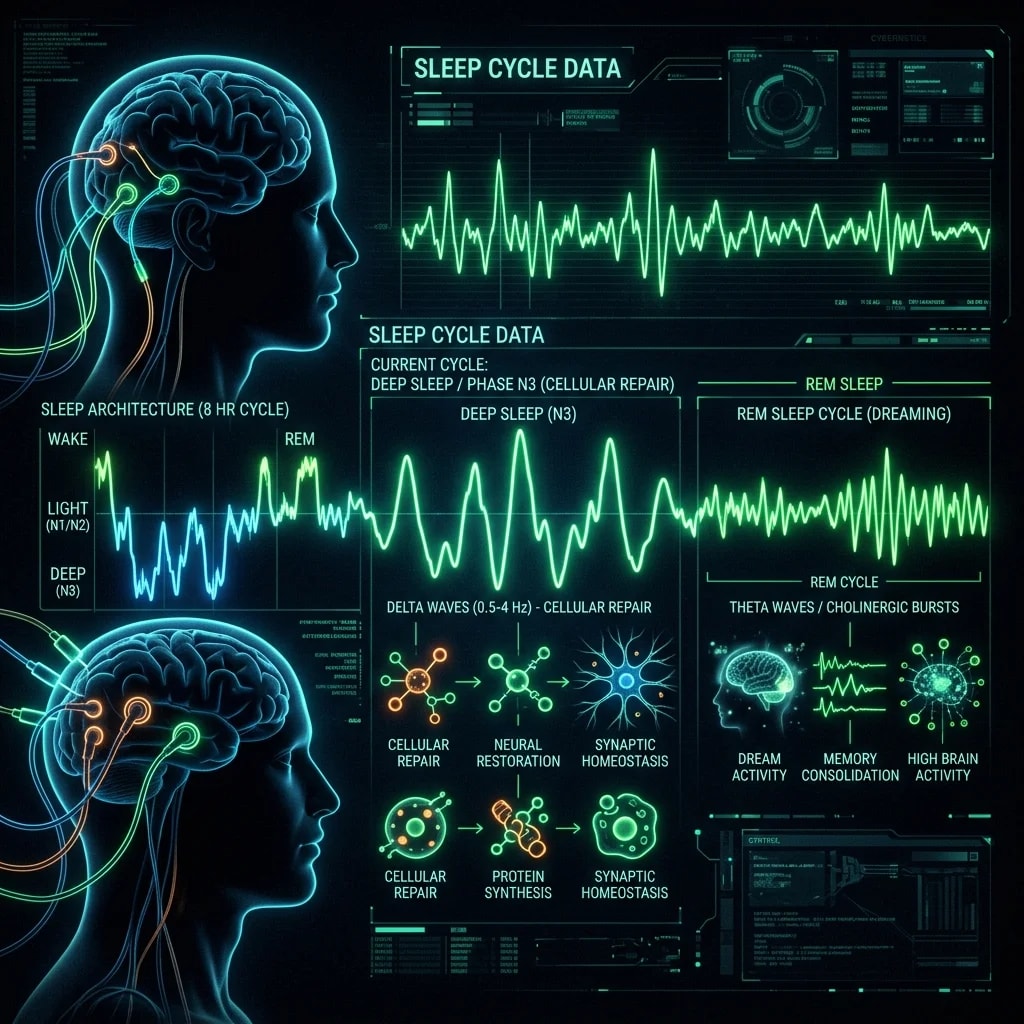
Sleep: The Foundation of Every Biological System
No drug, supplement, or intervention in longevity research matches the evidence base for adequate sleep. In a universe where most anti-aging interventions show modest effects, sleep deprivation consistently and dramatically accelerates aging markers — and sleep optimization consistently reverses them. Matthew Walker, Director of UC Berkeley's Center for Human Sleep Science, summarizes it starkly: "Every major disease killing people in the developed world — Alzheimer's, cancer, obesity, diabetes, depression — has strong causal links to sleep deficiency."
This is not hyperbole. The mechanistic pathways connecting inadequate sleep to accelerated biological aging are among the best-characterized in all of longevity science.
What Happens in Your Body During Sleep (And What You Lose Without It)
Stage 1–2: Light Sleep (NREM)
Body temperature decreases, heart rate slows, muscle activity reduces. Memory consolidation begins, with hippocampal replay of daytime experiences. Cardiovascular recovery initiates. This stage is relatively robust and is the least disrupted by sleep restriction.
Stage 3: Deep Sleep (Slow-Wave Sleep / N3)
The most biologically critical phase for physical restoration:
- Growth hormone secretion: 50–75% of daily GH is released during this stage. GH drives protein synthesis, fat metabolism, tissue repair, and immune function. Without deep sleep, GH pulse amplitude drops dramatically — mimicking the natural age-related GH decline that begins in the 30s.
- Glymphatic clearance: The brain's waste removal system (glymphatic) is 10–60× more active during deep sleep than waking. It clears amyloid-beta, tau proteins, and metabolic waste products — the same proteins that accumulate in Alzheimer's disease. Even one night of poor sleep measurably increases amyloid-beta burden in human brains (visualized via PET scan).
- Cellular repair: DNA damage repair enzymes are active during deep sleep. Cells address oxidative DNA damage from the day's metabolic activity. Chronic sleep deprivation is associated with accumulation of unrepaired DNA damage.
REM Sleep
Emotional processing, memory integration, creative cognition, and long-term memory consolidation. REM is also when testosterone, cortisol, and other hormones are regulated. REM deprivation specifically impairs insulin sensitivity and glucose metabolism within 3 nights.
The Biological Age Acceleration Effect
Epigenetic Clock Studies
The Horvath epigenetic clock — a DNA methylation-based biological age marker — reveals measurable acceleration with chronic poor sleep. Studies show:
- Adults sleeping <6 hours per night have epigenetic ages 1.5–3 years older than their chronological age versus those sleeping 7–8 hours
- The effect compounds: a decade of <6-hour sleep may add 3–5 years to biological age
- Shift workers (chronically disrupted circadian rhythms) show accelerated epigenetic aging equivalent to 8–10 pack-years of smoking in some analyses
Telomere Shortening
Telomere length — the protective caps on chromosomes that shorten with cellular aging — is significantly shorter in chronic poor sleepers in multiple large cohort studies. A 2014 analysis of 2,935 adults found significantly shorter telomeres in those averaging <6 hours/night versus 7–8 hours, independent of other aging risk factors.
Inflammatory Acceleration
Even one night of sleep restriction (4–6 hours) triggers measurable increases in NF-κB activation — the master inflammatory transcription factor. Chronic sleep deprivation produces sustained elevation of IL-6, CRP, and TNF-alpha, all markers of accelerated biological aging and primary risk factors for cardiovascular disease, diabetes, and neurodegeneration.
Sleep Duration and All-Cause Mortality: The Evidence
| Average Sleep Duration | All-Cause Mortality Effect |
|---|---|
| <5 hours/night | +65% higher all-cause mortality (meta-analysis: 16 studies, 1.3M participants) |
| 5–6 hours/night | +13% higher all-cause mortality |
| 7–8 hours/night | Lowest mortality reference group |
| 8–9 hours/night | +5–10% higher mortality (possibly confounded by illness) |
| >9 hours/night | +17% higher mortality (often confounded by illness requiring more rest) |
The sweet spot is consistently 7–8 hours for most adults. Both extremes (chronic short sleep and chronic long sleep) show elevated mortality in large-scale analyses, though long sleep is often a marker of underlying illness rather than a direct cause.
5 Evidence-Based Sleep Optimization Strategies
1. Consistent Sleep Schedule (Most Important)
Going to sleep and waking at the same time every day — including weekends — is the single most powerful sleep quality intervention. Circadian rhythm disruption ("social jetlag") causes the same inflammatory and hormonal effects as sleep deprivation even with the same total hours.
2. Temperature Optimization
Core body temperature must drop ~1°C to initiate sleep and stay low for deep sleep maintenance. Optimal bedroom temperature: 65–68°F (18–20°C). Cold exposure in the 1–2 hours before bed (cool shower, cool environment) accelerates the temperature drop and improves both sleep onset and deep sleep percentage.
3. Light Management
Blue light (450–480nm wavelength) suppresses melatonin production with 200× the potency of red light. Screens, LED lighting, and fluorescent light at night delay melatonin onset by 1–3 hours, delaying sleep onset and reducing deep sleep. Conversely, 10–30 minutes of bright morning light exposure within 30–60 minutes of waking anchors the circadian clock and improves nighttime sleep quality.
4. Caffeine Cutoff
Caffeine's half-life is 5–7 hours in most adults (up to 10–12 in slow caffeine metabolizers). A coffee at 2pm still has 50% of its sleep-disrupting adenosine blockade active at 8pm in average metabolizers. Optimal cutoff: no caffeine after noon for most adults to protect deep sleep architecture.
5. Alcohol Avoidance Within 3 Hours of Sleep
Alcohol is sedating but not sleep-inducing in a physiological sense. It fragments sleep in the second half of the night, suppresses REM sleep by 20–25%, and reduces slow-wave sleep quality. Even 1 drink within 3 hours of sleep measurably reduces sleep quality in polysomnography studies.
Check Your Biological Age Metrics
Open Age CalculatorFrequently Asked Questions
Does poor sleep accelerate aging?
Yes, measurably. Epigenetic clock studies show chronic poor sleepers (<6 hours) have biological ages 1.5–3 years older than chronological age. The mechanisms include telomere shortening, inflammatory gene expression, reduced growth hormone, impaired DNA repair, and accumulated amyloid-beta burden.
How many hours of sleep do I need to prevent aging?
7–8 hours per night for most adults is the optimal range associated with lowest all-cause mortality and slowest biological aging in large population studies. Consistent sleep timing matters as much as duration.
Can you reverse sleep deprivation damage?
Short-term sleep debt can be partially recovered. Chronic sleep deprivation's epigenetic and inflammatory effects appear to be partially reversible with sustained sleep improvement. However, sleep debt from years of poor sleep cannot be fully "paid back" in a weekend of oversleeping — consistent long-term improvement is required.

DC EDITORIAL
Expert analysis on biological data, temporal mechanics, and digital wellness. Committed to providing accurate, data-driven insights for the next generation.