Chronological Age vs. Biological Age: The Difference That Could Save Your Life
Your birthday says one thing. Your cells say another. Understanding the gap between chronological and biological age is the foundation of modern longevity science — and you can measure it.
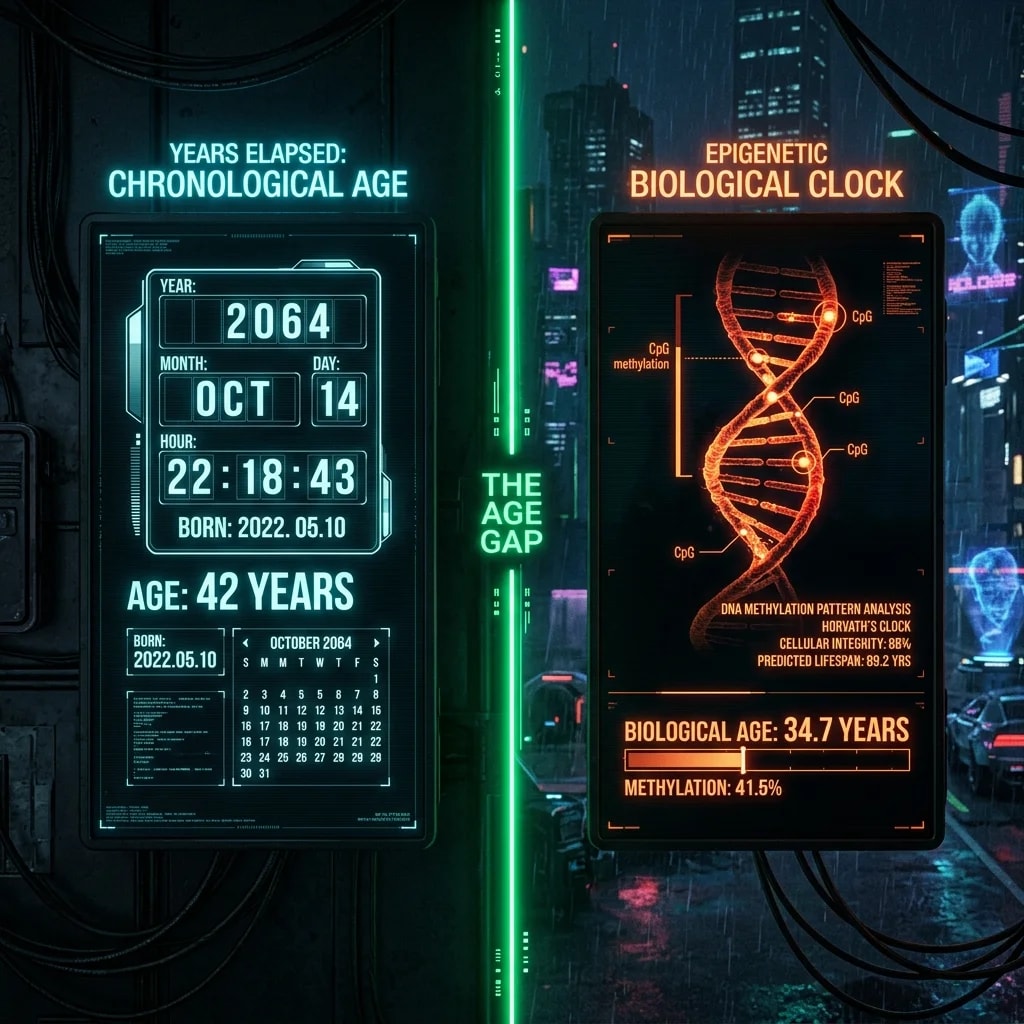
Two Ages, One Body
You have two ages, and only one of them is on your passport. Your chronological age is a count of orbits — how many times Earth has circled the sun since your birth. Your biological age is something fundamentally different: a measurement of how rapidly your cells, tissues, and organs are deteriorating relative to population averages.
Two 45-year-olds — born on the same day — can have biological ages of 35 and 58. The difference is not genetic lottery: it's lifestyle, environment, habits, and accumulated stress. More importantly, biological age is modifiable. You can actively change it.
This is one of the most clinically significant discoveries in modern medicine — and it's reshaping how doctors, insurers, and longevity researchers think about health.
What Actually Determines Biological Age?
Epigenetic Clocks: The Methylation Revolution
In 2013, UCLA biostatistician Steve Horvath published a landmark paper introducing the first validated epigenetic clock — the Horvath Clock. By measuring DNA methylation patterns (chemical tags that turn genes on or off) at 353 specific sites in the genome, Horvath was able to predict a person's biological age with remarkable accuracy.
DNA methylation changes predictably with age, but at a rate that accelerates with stress, disease, and unhealthy behaviors — and decelerates with healthy lifestyle choices. Subsequent clocks (PhenoAge, GrimAge, DunedinPACE) have refined this dramatically. The Dunedin Pace of Aging clock can calculate how many years a person biologically ages per chronological year — some people age 1.5 years biologically for every calendar year; others age just 0.7 years.
Telomere Length
Telomeres are protective caps at the ends of chromosomes, analogous to the plastic tips on shoelaces. Each time a cell divides, telomeres shorten. When they become critically short, the cell either stops dividing (senescence) or dies. Shorter telomeres correlate with older biological age and higher disease risk.
Chronic stress, smoking, poor sleep, sedentary behavior, and a diet high in processed foods all accelerate telomere shortening. Exercise — particularly endurance training — has been shown to actually lengthen telomeres in some research populations.
Inflammatory Markers
Chronic low-grade inflammation — informally called inflammaging — is a key driver of biological aging. Blood markers like hs-CRP (high-sensitivity C-reactive protein), IL-6, and TNF-alpha all rise with accelerated biological aging. These are measurable with a standard blood panel.
The Gap: What a Difference of 5 Years Biologically Means
Research from the Stockholm Sibling Study showed that a biological age 5 years younger than chronological age correlates with:
- 35% lower risk of cardiovascular disease
- 19% lower risk of type 2 diabetes
- 28% lower risk of dementia
- 26% lower all-cause mortality
Conversely, being biologically 5 years older increases these risks by comparable margins. This is why biological age is increasingly used by longevity clinics to guide intervention priorities rather than chronological age.
How to Estimate Your Biological Age Without a Lab
Full epigenetic testing (from companies like TruDiagnostic, Elysium, or SiPhox Health) remains expensive — typically $200–600 per test. But several proxy indicators can give you a directional estimate:
Grip Strength
The UK Biobank study found grip strength to be one of the strongest physical predictors of biological age available without lab tests. Lower-than-average grip strength for your age/sex strongly correlates with accelerated cellular aging.
Resting Heart Rate
A resting heart rate above 80 bpm is independently associated with accelerated biological aging. Athletes frequently have resting heart rates in the 40s, reflecting exceptional cardiovascular fitness and slower biological aging pace.
VO2 Max
Cardiorespiratory fitness, measured as VO2 max (maximum oxygen consumption), is perhaps the single strongest clinical predictor of lifespan available without epigenetic testing. A 1-MET (metabolic equivalent) improvement in VO2 max is associated with 13% lower all-cause mortality.
Waist Circumference
For women, a waist over 35 inches (88cm) correlates with elevated biological aging markers. For men, the threshold is 40 inches (102cm). These cutoffs mark visceral adiposity levels associated with accelerated aging. Measure yours and calculate your body fat percentage with our US Navy calculator.
Can You Reverse Biological Age?
Yes — this is now scientifically established, not speculative. Several interventions have demonstrated measurable biological age reversal on epigenetic clocks:
- The Fahy Thymus Protocol: A 2019 pilot trial showed 2.5-year reversal in biological age using growth hormone + DHEA + metformin over 12 months.
- Intensive lifestyle intervention: Eight weeks of diet (Mediterranean-style), 7h+ sleep, stress reduction, and exercise produced a 3.23-year reduction in Horvath biological age in a 2023 randomized controlled trial.
- Caloric restriction: The CALERIE trial found that 12% caloric restriction over 2 years reduced the pace of aging (DunedinPACE) by 2–3%. Equivalent to slowing your aging speed by that percentage.
Start With Your Chronological Stats
Before diving into epigenetic testing, start with the basics: know your exact chronological age in granular detail, track your life battery, and measure your body composition. These free, accessible metrics form the foundation of any serious longevity practice.
Calculate Your Chronological Age & Life Stats
Open Age CalculatorFrequently Asked Questions
What is biological age vs chronological age?
Chronological age is the number of years since birth. Biological age is the functional age of your cells, tissues, and organs — how old your body actually operates compared to population averages of the same calendar age.
Can lifestyle really change biological age?
Yes. Multiple controlled studies have demonstrated measurable epigenetic clock reversal through lifestyle interventions (sleep, diet, exercise, stress reduction) within 8–52 weeks.
How do I calculate my biological age for free?
Proxy indicators include grip strength, resting heart rate, VO2 max, and waist circumference. Full epigenetic testing costs $200–600. Our calculator provides your chronological time profile as a free starting point.

DC EDITORIAL
Expert analysis on biological data, temporal mechanics, and digital wellness. Committed to providing accurate, data-driven insights for the next generation.